
Discover the Best Smart Entertainment Services in 2026
The modern home theater has undergone a profound transformation. In 2026, the traditional concept of static media streaming is fading into legacy status. Consumers now demand dynamic, multi-sensory experiences that blend spatial computing, neural algorithms, low-latency rendering, and ultra-high-definition fidelity. Navigating this vast landscape of digital content requires more than just subscribing to random networks; it demands a strategic understanding of modern Smart Entertainment Services.
With subscription costs shifting and platforms combining, selecting premium options can feel overwhelming. Many streaming brands emphasize flashiness over actual features, while some hide advanced features behind higher pricing tiers. This guide analyzes current options honestly and realistically. It helps you design an perfect digital home theater that respects your hardware ecosystem and stays within your budget. Let us look at what makes modern platforms stand out this year.
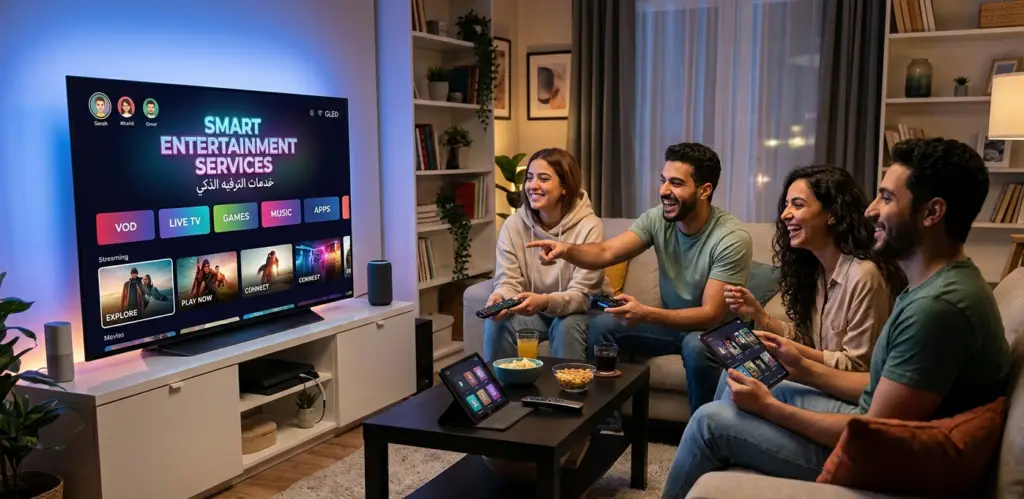
Achieving premium play quality requires matching raw bandwidth requirements and selecting services that integrate with your smart home gadgets. Many modern television screens come equipped with native neural upscaling options. However, these features perform best when the backend streaming service sends a high-bitrate source material. Selecting the right hub ensures that your television hardware, spatial audio speakers, and home lighting grids operate in perfect harmony.
Identify Your Entertainment Profile and Personal Preferences
Before subscribing, evaluate your household viewing patterns. Consumers tend to fall into distinct user categories. Understanding your profile helps you avoid subscribing to platforms you will rarely use. Let us examine the four core entertainment profiles:
- The Purist Cinephile: This viewer values uncompressed raw bitrates, native 24p frame rates, complete HDR10+ or Dolby Vision profiles, and reference-grade theatrical audio. This profile demands services that stream premium source archives without heavy artifact compression.
- The Immersive Gamer: This user skips traditional pre-recorded videos in favor of ultra-low-latency interactive feeds, virtual spaces, and remote server gaming. This user needs high frame-rate rendering and clean controller response times.
- The Multi-Device Casual: This viewer streams primarily on tablet screens during commutes or on mobile phones. This profile prefers offline storage modes, smart download triggers, and highly clear dialog restoration features, rather than cinematic bitrates.
- The Spatial Pioneer: This user owns advanced virtual reality goggles or mixed-reality spectacles. This profile tracks services offering three-dimensional projection formats, interactive viewpoints, and collaborative watch parties.
- The Unified Family Hub: This household hosts multiple active streams at once on different screens. They prioritize strong profile customization, independent playlist curation, and helpful parent access limitations.
- The Background Listener: This user treats television as wallpaper ambient noise or relaxes to ambient lo-fi music playlists. They require smart discovery hubs that auto-play matching loops and transition smoothly across dynamic volumes.
Take a moment to write down what matches your household. By classifying your primary viewing profile, you can avoid subscribing to bloated packages. This saves hundreds of dollars annually while ensuring you get the exact video standard you expect.
Plan Your Subscription Strategy and Content Budgets
Subscription creep remains a major challenge. In 2026, many leading services rely on tiered plans, making monthly fees accumulate fast if you do not track them actively. Creating a structured subscription management plan helps you keep costs low. Try using these eight deliberate tips:
- Define a Ceiling Limit 📌 Determine an absolute monthly dollar cap for digital services before signing up for any trial. This absolute limit keeps subscription habits in check.
- Rotate Specialty Tiers 📌 Avoid maintaining active subscriptions to three different cinephile channels at once. Rotate channels based on seasonal releases or major show schedules.
- Assess Hardware Bundling 📌 Many premium soundbars, internet providers, or smartphones come with free promo periods for leading platforms. Audit active devices to reclaim free access.
- Review Active Profiles 📌 Check list views in account settings once every quarter. Ensure old guest profiles from forgotten roommates or friends do not drive up parallel screen costs.
- Select Quarterly Savings 📌 Platforms occasionally offer mid-tier annual options which discount prices by thirty percent compared to monthly billings. Commit to platforms you use daily.
- Audit Mobile Surcharges 📌 Avoid subscribing directly inside mobile app stores when a website purchase is cheaper. Web platforms bypass application store fees and save costs.
- Prefer Unified Accounts 📌 Opt for combined suites where video, audio, and streaming spatial packages exist under a single, simplified payment mechanism.
- Leverage Free Tiers 📌 Many popular services now offer free, hybrid ad-supported plans. Utilize these plans for casual viewing to cut unnecessary spending entirely.
To help you compare the top players in the market today, we gathered real performance metrics, pricing tiers, and rating metrics for the leading 2026 options. Use this honest comparison table below as a realistic checklist to decide which provider matches your household budget and digital goals.
| Service Class | Leading Platform | 2026 Basic Tier (Est) | Standout Feature | Acoustic Level | Score (1-10) |
|---|---|---|---|---|---|
| Neural Streaming | Netflix Atmos Ultra | $15.49 / mo | Interactive branches & adaptive resolution | Standard Dolby 7.1 | 9.4 |
| Spatial Music | Spotify Supreme HD | $12.99 / mo | Smart DJ loops & personalized HRTF matching | Custom Binaural | 9.1 |
| Cloud Gaming | GeForce NOW Ultimate | $19.99 / mo | Dynamic RTX upscaling & instant co-op links | Low Jitter Audio | 9.6 |
| Spatial 3D Spaces | Meta Horizon Lounge | $9.99 / mo | Co-presence avatars & shared theaters | Full Spatialized HRTF | 8.7 |
Focus on Streaming Resolution and Spatial Audio Quality
Visual and auditory fidelity defines the ultimate smart entertainment experience. If you subscribe to a high-end service but stream over limited connections, you will encounter immediate buffering or quality drops. Ensuring you have the right local parameters configured will guarantee clean presentation. When reviewing your digital setup, focus on these critical quality criteria:
- Bandwidth Preservation Ensure your download speed sustains a stable 50 Megabits per second for UHD feeds. Connect streaming console devices directly using high-quality Ethernet wiring to minimize local latency and packet loss.
- Decoder Compatibility Review your local TV hardware codecs. Choose apps that support dynamic metadata compression formats like AV1 or HEVC, which display high visual details using less local data.
- Ambient Screen Calibration Turn off aggressive interpolation features often referred to as motion smoothing on your screen settings. Set your profile to Filmmaker Mode to view movies exactly as cinematic directors intended.
- Spatial Ear Mapping Some modern music platforms now offer custom head tracking and ear shape scans. Completing this ear mapping creates an customized Head-Related Transfer Function profile for superb headphone experiences.
- Contrast Balancing Verify that your platform streams source files with high bitrates in dark scenes. High-end services run optimized encoding loops that eliminate gray block gradients and noise in dim sections.
- Audio Pass-Through Mode Enable direct raw sound pass-through inside spatial soundbars and receiver consoles. This configuration lets external speakers decode DTS:X or Dolby Atmos tracks natively without early digital downmixing.
- Dynamic Level Control Reduce loud background action sound elements while highlighting dialogue ranges using intelligent volume stabilization tools available in high-end streaming services.
By prioritizing these exact visual parameters, you can get the full value out of high-end home theater setups. It is easy to notice when these parameters are optimized; movies look cleaner, music surrounds you realistically, and interactive games feel far more direct and clean.
Leverage Intelligent Recommendation Engines and Neural Content Discovery
Modern applications rely on state-of-the-art recommendation engines to suggest shows and movies. In the past, services recommended titles based solely on broad movie categories like Comedy or Sci-Fi. Under modern paradigms, platforms analyze contextual factors, such as pacing, visual styles, conversational complexity, and active sound tracks.
Understanding how these algorithms build your feed enables you to train recommendation lists strategically. If you share active profiles with multiple family members, the dashboard will inevitably output confusing title recommendations. Make sure to create separate profiles for every user in your house to prevent profile data clutter.
Take time to adjust your recommendation feeds. Most modern interactive platforms provide a preference resetting tool inside account settings page. If your daily lists feel cluttered or out of taste, run a quick baseline profile reset to clear old parameters and start fresh.
Interact with Multi-User Watch Parties and Real-Time Co-Streaming
Social connectivity forms another pillar of modern Smart Entertainment Services. Today, watching a film is no longer a solitary activity restricted to local seating. High-speed, fiber-optic channels allow multi-user video feeds to synchronize seamlessly across different time zones. Let us review the primary real-time features you should leverage:
- Interactive Co-Browsing:👈 Join collaborative virtual lobbies where multiple friends can swipe through active title lists concurrently. The system selects titles matching all users’ favorite categories automatically.
- Integrated Call Overlays:👈 Enable picture-in-picture video feeds of your close friends on the side of your main screen. The main audio balances dynamically when someone speaks during intense scenes.
- Synced Track Control:👈 Establish a shared session where pausing, rewinding, or fast-forwarding is shared across all screens. Synchronized frames avoid spoiling critical plot segments.
- Visual Dynamic Filters:👈 Use customizable reactive filters during watch sessions. Your avatars can throw virtual items on screen or output emoji sparkles in reaction to major movie climaxes.
- External Chat Sync:👈 Link companion mobile applications directly with host screen channels. This integration lets you post text replies or reactions on screen without using slow on-screen keyboards.
- Joint Profile Playlists:👈 Compile collaborative watch lists with fellow group members. The playlist dynamically updates as users contribute, providing centralized group queues.